Situation
A novel drug therapy had shown promising clinical results in reducing adverse events and improving survival outcomes. However, in a competitive healthcare environment where adoption decisions are increasingly driven by cost-effectiveness, clinical results alone were not sufficient. Clinicians, healthcare organizations, payers, and investors required strong, quantifiable evidence that this therapy could deliver economic as well as clinical value, particularly by reducing costs associated with side effects, comorbidities, hospitalizations, and mortality.
Challenge
- Lack of Long-term Cost Impact Data: Clinical trial data did not directly capture long-term cost impacts or downstream economic benefits, limiting the ability to demonstrate value beyond efficacy and safety.
- Difficult Decision Making: Payers and healthcare decision-makers needed robust health economic evidence to justify coverage, formulary inclusion, and reimbursement at a premium price point.
- Uncertain Comparative Value: Without clear data gathering or modeling of real-world cost savings and health benefits, payors, investors and clinicians faced uncertainty about the therapy’s comparative value and market potential.
The Xelay Approach
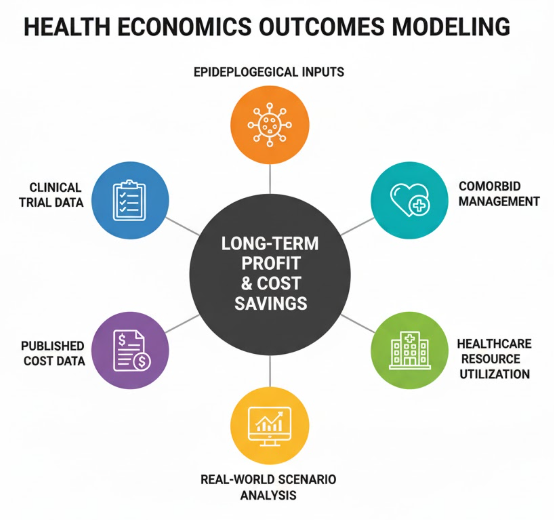
- Built a comprehensive health economics outcomes model integrating clinical trial data, epidemiological inputs, healthcare resource utilization, and published cost data.
- Simulated real-world treatment scenarios to quantify cost offsets through reduced rates of adverse events, hospitalizations, and comorbid condition management, as well as gains from reduced mortality.
- Produced clear, evidence-driven outputs tailored for multiple stakeholders:
- Clinicians: clinical and economic rationale for selecting the novel therapy.
- Healthcare organizations and payers: quantifiable cost savings supporting coverage and formulary inclusion.
- Investors: robust demonstration of long-term value creation and market differentiation.
- Delivered results in high-quality visualizations and publications, enabling stakeholders to readily understand the total value proposition of the therapy.